PayPal works when you’re starting out. You share your PayPal.me link, clients pay you after a session, and the money shows up in your account. Simple. For a trainer charging $100–$200 per session with a handful of clients, there’s nothing wrong with that setup.
The problems start when you grow. The moment you launch an online program, sell memberships, run recurring billing, or process more than $10K/month — PayPal becomes a liability, not a convenience. Here’s where the line is and what to do when you cross it.
Where PayPal Works for Fitness Businesses
If you’re an independent personal trainer doing in-person sessions, PayPal handles the basics:
- Sending invoices after sessions
- Sharing a PayPal.me link for quick payments
- Accepting card payments without a separate gateway
- Getting paid same-day with instant transfers (1.75% fee)
For trainers under $5K/month with mostly one-time payments, it’s fine. No application, no underwriting, no setup. That’s the appeal.
Where PayPal Breaks for Fitness Businesses
Recurring billing gets you flagged. Monthly memberships, class packs, and subscription programs are where PayPal’s risk system starts paying attention. A few clients disputing their monthly charge — because they forgot to cancel, not because you did anything wrong — and PayPal freezes your account. They don’t distinguish between a legitimate fitness membership and a scam.
Volume spikes trigger reviews. You run a January fitness challenge, 200 people sign up in a week, and PayPal flags the sudden volume increase as suspicious. Your funds are held while they “review” your account. Meanwhile, you can’t pay your rent or your team.
Supplement sales get you shut down. If you sell protein, pre-workout, or any supplement products alongside your training — PayPal considers that a restricted category. Mixing coaching and supplements on the same PayPal account is one of the fastest ways to get terminated.
No class packs or membership tiers. PayPal doesn’t natively support selling 10-class packs, drop-in rates, or tiered memberships. You end up cobbling together workarounds with manual invoices or third-party tools — none of which integrate cleanly.
You don’t own your payment data. If PayPal freezes you, your client payment info stays with PayPal. Every subscriber has to re-enter their details with your new processor. With a dedicated merchant account, your tokenized card data is portable.

What Are the Best Alternatives to PayPal for a Fitness Business?
Depends on where you are in your business:
Just starting, under $5K/month: PayPal or Stripe is fine. Build 3–6 months of clean processing history — you’ll need it later when you apply for a dedicated merchant account.
Growing, $5K–$25K/month: Start the conversation about a dedicated merchant account. You’re not in crisis yet, but you’re approaching the volume where PayPal starts flagging accounts. Set up now while you have clean history to show.
Scaling, $25K+/month or selling memberships: You need a dedicated merchant account with a proper payment gateway. Interchange-plus pricing saves you 15–30% vs PayPal’s flat rate. Recurring billing runs through your gateway with automated retries. And nobody freezes your account during your biggest launch month.
For a deeper look at what a fitness merchant account involves, see our full guide.
How Do I Migrate My Clients Away from PayPal?
This is the part that scares people, but it’s straightforward:
- Set up your new merchant account and gateway while you’re still on PayPal. Don’t cancel PayPal first.
- New clients go through your new checkout. Existing clients stay on PayPal temporarily.
- Email existing subscribers with a link to update their payment method on your new system. Most will do it if you make it one click.
- Once everyone’s migrated, downgrade PayPal to a backup or close it.
The whole process takes 2–4 weeks. Your clients barely notice.


Common Questions
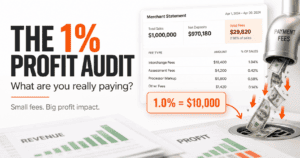
3.49% + $0.49 per transaction for standard payments. 1.75% for instant transfers to your bank. Chargeback fee is $20. No monthly fee, but the per-transaction cost adds up fast — a trainer processing $10K/month pays ~$400 in PayPal fees vs ~$250–$350 on a dedicated merchant account.
Yes — PayPal has a subscription billing feature. But it’s basic, inflexible, and any chargeback on a recurring charge puts your entire account at risk. A dedicated gateway gives you automated retries, account updater for expired cards, and your subscription billing doesn’t live on a platform that can freeze you.
Safe for the client, risky for you. PayPal.me links are convenient but offer zero chargeback protection and no documentation trail. If a client disputes, you have no proof of what was purchased. For anything beyond casual one-off sessions, use an invoicing system that documents the service.
Platforms like Mindbody, Vagaro, and GloFox handle scheduling and payments together. They’re convenient but run on aggregator processing underneath — same freeze risk as PayPal. A dedicated merchant account connected to your booking platform gives you the best of both: fitness-specific features with stable processing.
The Bottom Line
PayPal is where fitness businesses start. It’s not where they should stay. If you’re scaling past $10K/month, running memberships, or selling supplements alongside coaching — the question isn’t whether PayPal will freeze you, it’s when. Get set up with proper processing while your history is clean and your business is growing, not after everything stops. Let’s talk.