If you run an online business, you may have considered Mercury, Slash, Airwallex or Novo as an alternative to a traditional business bank.
They all make it easier to manage business finances online, but they are not interchangeable.
Mercury is popular with startups and online businesses. Slash offers more detailed controls over how money moves. Airwallex is built heavily around international and multi-currency businesses. Novo is geared toward smaller businesses and integrates with services such as Stripe.
But there is another difference that matters if you accept credit cards:
Your business bank account is part of your payment-processing infrastructure.
If the account connected to your payment processor is restricted, frozen or closed, your processor may suddenly have nowhere to send your settlements. And if it cannot debit the account for fees, chargebacks or other amounts you owe, the problem can potentially affect your merchant account too.
That is why choosing an online business account should involve more than comparing apps, cards and fees.
Watch: Mercury vs Slash vs Airwallex vs Novo
In this episode of Click & Convert, I compare the four platforms and explain one risk that online businesses frequently overlook: the actual bank sitting behind the fintech account.
Mercury vs Slash vs Airwallex vs Novo: Quick Comparison
| Platform | Best suited for | Banking structure | Main issue to consider |
|---|---|---|---|
| Mercury | U.S. startups and online businesses | Choice Financial Group and Column N.A. | Find out which underlying bank holds your particular account |
| Slash | Businesses wanting detailed cash and ACH controls | Column N.A. | ACH controls can affect processor debits if not configured correctly |
| Airwallex | International and multi-currency businesses | Varies by market/product | Confirm your particular account works for merchant settlements and debits |
| Novo | Smaller U.S. businesses | Middlesex Federal Savings | Straightforward option, but still a fintech rather than the underlying bank |
Banking arrangements can change, so always verify the current banking provider attached to your particular account before relying on it as a primary or backup relationship.
Are Mercury, Slash, Airwallex and Novo Actually Banks?
Mercury, Slash and Novo are fintech companies rather than banks themselves. Airwallex is also a financial technology and payments company rather than a traditional bank.
Mercury states that its banking services are currently provided through Choice Financial Group and Column N.A. Mercury
Slash states that banking services are provided by Column N.A. Slash
Novo states that it is a fintech and that banking services are provided by Middlesex Federal Savings, F.A. Novo
Airwallex operates across multiple jurisdictions and financial products, so its structure is more complex. In the U.S., it says Evolve Bank & Trust provides payment services to certain U.S.-based customers. airwallex.com
That distinction matters because the name you see when you log into an app isn’t necessarily the institution actually holding the deposit account.
What Is Mercury Best For?
Mercury is a strong option for U.S.-focused startups and online businesses that want banking, cards, wires and financial-management tools in one online platform.
The issue I would pay attention to isn’t whether Mercury is good or bad. It is which Mercury partner bank actually holds your account.
Mercury currently works with both Choice Financial Group and Column N.A.
Why does that matter?
Because if your Mercury account happens to be held at Column and you open Slash as your backup, you may think you have diversified across two separate banking relationships.
But Slash also uses Column.
You would have two fintech platforms and two account numbers—but potentially the same underlying bank.
What Is Slash Best For?
Slash can be attractive to businesses that want more control over cash management and ACH activity.
One feature worth understanding is its ACH authorization system.
Slash allows businesses to authorize specific vendors and place limits on the amount those vendors are allowed to debit.
That can be an excellent security feature.
But if Slash is receiving your merchant-account settlements, those controls need to be configured correctly.
Your processor depositing $100,000 into the account does not necessarily mean that the same processor is automatically authorized to debit $10,000 or $20,000 later.
And your processor may need to pull money for:
- processing fees
- chargebacks
- refunds
- negative balances
- other processing adjustments
Before using an account with ACH controls for settlement, ask your processor for its ACH company/originator ID and determine how large its potential debits may be.
What Is Airwallex Best For?
Airwallex makes the most sense when international banking and multiple currencies are important to the business.
Its Global Accounts can receive money using local banking rails in numerous markets and currencies, and its infrastructure supports businesses operating across multiple countries.
That can make Airwallex especially useful if you:
- sell internationally
- collect multiple currencies
- pay overseas suppliers
- frequently convert currencies
- operate across several markets
Airwallex also offers payment-processing products itself, so it is broader than simply an online business-account provider.
If you plan to use an Airwallex account with a different merchant processor, however, confirm first that the processor will settle into that particular account structure and can perform any required debits.
Don’t assume that because an account can receive a transfer, it automatically meets your processor’s settlement requirements.
What Is Novo Best For?
Novo is geared more toward small businesses looking for a straightforward online business account.
Its banking services are provided by Middlesex Federal Savings, and it also integrates with online-business tools such as Stripe.
For a business already receiving Stripe payouts, that simplicity may be appealing.
Novo is also interesting from a backup perspective because its underlying banking provider is different from Column, which sits behind Slash and some Mercury accounts.
That does not automatically make Novo the best backup. It simply illustrates why the underlying bank matters as much as the fintech brand.
Can Losing Your Business Bank Account Affect Your Merchant Account?
Yes. Losing your settlement account can create a serious problem for your payment processor and, if it isn’t resolved, can lead to restrictions or potentially the loss of your merchant account.
Most merchants think payment processing works in one direction:
Processor → Your bank
You make sales and the processor sends you the money.
But the financial relationship can work in both directions:
Your bank → Processor
The processor may need to collect processing fees, chargebacks and other adjustments.
For example, assume a merchant processes $1 million per month and has approximately $30,000 in processing costs.
If the processor attempts to debit those fees and the transaction is rejected because of the bank account’s controls, the processor may simply see that it attempted to collect money it was owed and was unable to do so.
Depending on the processor and how quickly the issue is resolved, that can result in additional scrutiny, holds, reserves or processing restrictions.
If the bank account is closed completely and the processor cannot settle funds or collect amounts owed, the merchant may ultimately need to provide another acceptable settlement account to keep processing.
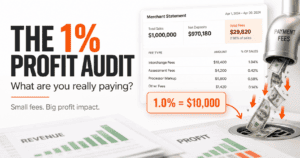
This is also why understanding the true cost and structure of your payment relationship matters. If you use Stripe, our recent Stripe Fees Breakdown: What Stripe Really Costs Merchants in 2026 explains the fees that can exist beyond the advertised processing rate.
Could Your Banking Setup Put Your Merchant Account at Risk?
If you’re processing meaningful online volume and aren’t sure whether your bank account, ACH controls or settlement setup works properly with your processor, DirectPayNet can review the payment side of the relationship before it turns into a funding problem.
How Can You Prevent Your Bank From Rejecting Processor Debits?
Before using an online business account for processing settlements, ask your processor for:
- its ACH company or originator ID
- the name its debit will appear under
- the largest debit you should reasonably expect
- whether chargebacks and processing fees use different debits or IDs
- whether your processing fees are collected daily or monthly
Then confirm with your banking provider that those transactions will be permitted.
This is particularly important with a platform such as Slash because its ACH policies can use vendor-specific authorizations and transaction limits.
You can also ask your processor whether daily discounting is available.
Instead of allowing a large amount of processing fees to accumulate and then hitting the bank account with one substantial debit at the end of the month, the processor may be able to deduct fees from settlements as transactions are processed.
Not every processor or account is structured the same way, so this needs to be confirmed with your provider.
Why Two Online Bank Accounts May Not Be a Real Backup
A backup account should give you a genuinely separate banking relationship—not simply another login and account number.
Consider these examples:
| Primary | Backup | Underlying-bank diversification |
|---|---|---|
| Mercury account at Column | Slash | No — both depend on Column |
| Mercury account at Choice | Slash | Yes — different underlying banks |
| Slash | Novo | Yes — Column vs Middlesex |
This doesn’t mean having Mercury and Slash is useless.
The platforms themselves are different, and having access to two accounts can still provide operational benefits.
But if you’re trying to protect your business against a problem with an underlying bank, you need to go one level deeper.
Check which bank actually holds each account.
The same idea applies to your payment processing.
A growing business should think about redundancy before something gets shut down, not after.
For businesses that have outgrown a simple third-party processing arrangement or need a more stable processing relationship, you can also read about High-Risk Merchant Accounts and how a dedicated merchant account differs from relying entirely on a payment platform.
What Should You Look for in a Backup Business Bank Account?
A real backup should pass four tests.
Different underlying bank.
Don’t assume a different fintech logo means a different banking institution.
Compatible with your processor.
Ask whether the processor will approve the account for settlement.
Able to accept processor debits.
Make sure ACH filters and debit limits will not block legitimate processor activity.
Opened before you need it.
The worst time to start applying for another account is when your current account has already been frozen and your processor is trying to settle today’s sales.
That last point is the one I would emphasize most.
Redundancy works when it exists before the emergency.
Which Is Better: Mercury, Slash, Airwallex or Novo?
There isn’t one winner for every online business. The best choice depends on how your business operates and what you need from the account.
- Choose Mercury if you want a broad U.S.-focused online financial platform and its banking structure works with your business.
- Choose Novo if you’re a smaller U.S. business looking for a relatively straightforward account and useful ecommerce or payment integrations.
- Choose Slash if detailed financial and ACH controls are especially useful to you, but configure those controls with your processor in mind.
- Choose Airwallex if international banking, foreign currencies and cross-border operations are central to the business.
But don’t make the decision based only on features.
For an online business processing substantial credit-card volume, I would ask three additional questions:
Which bank is actually behind this account?
Can my processor both deposit into and debit the account?
If this relationship disappears tomorrow, do I have a genuinely independent backup?
Those questions can be much more important than which platform has the nicest dashboard.
The Bottom Line
Mercury, Slash, Airwallex and Novo can all be useful business financial platforms.
The risk isn’t simply using a fintech.
The risk is building your entire payment infrastructure around one banking relationship without realizing it.
Know the underlying bank. Understand your ACH controls. Confirm that your processor can settle funds and collect what it is owed. And have a second banking relationship in place before you need it.
Because when you run an online business, your bank account and your merchant account are not completely separate systems. They depend on each other.
Build a More Reliable Payment Setup
If you want to make sure your merchant account, business bank and settlement structure can support your business as it grows, DirectPayNet can help you review your current payment setup and identify potential weak points before they cause a disruption.